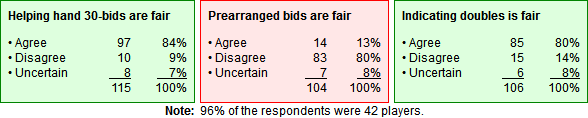
| Survey Results for Above Fair Play Items | ||
 |
||
|
QUOTE 9: During the past few years, there has been open discussion on the practice of bidding in the 32-34 range to indicate the relative strength of a player's helping hand. This sometimes occurs when 30 has already been bid, and an opponent also has a helping hand that he wants to indicate to his partner. This is fairly common in some locations; however, some players believe it is show-bidding and disapprove of the practice. Others believe it is no different from a generic helping hand 30-bid as long as it doesn't indicate specific information. Is this fair play if the practice is longstanding (like the 30-bid) and not knowingly prearranged? - PP Survey Form QUOTE 8: Another questionable practice is pausing before playing a trump domino to indicate to your partner that you have more than one trump in your hand. This is a tough nut to crack because it's difficult to prove that the delay is intentional. Sometimes a player just needs more time to decide which of his trumps to play in a given situatuion. If, indeed, the pause is intentional, is it really unfair since all at the table see it when it happens? For example, many purists agree that playing your double to indicate you're holding the next highest domino in that suit is okay since all players at the table see it and can deduce its meaning. If, however, the meanings of these indications are prearranged via private agreements between partners, then the practices might be considered unfair when all four players at a table are not privy to their meanings. - PP QUOTE 7: Some 42 clubs use bidding conventions that are known by all in their membership. When members team up as partners and play in tournaments outside their club, they have an advantage over opponents who are not familiar with their bidding conventions. In this case, signal bidding practices (Quote 1 below) would be appropriate, i.e., the opponents are told about the bidding conventions used. - PP QUOTE 6: Forty-two is both a simple and very complex game. Part of that complexity is learning your partner's tendencies through the course of a game. Noticing something you can use, and then capitalizing on it. Opponents are all able to do the same thing so no one is placed at a disadvantage. Private conversations between partners shortcut that process and provide an unfair advantage to a partnership, and have no place in forty-two. QUOTE 5: (Prearranged bidding) inherently requires a private meeting and understanding in advance between partners about their signals, and thus is clearly pre-meditated cheating. Even in the complicated card game of bridge, where it is normal for some information to be learned during the bid process about others’ hands, this type of pre-arranged signaling, or cheating, between partners is called “the gravest of offenses.” QUOTE 4: All's fair in love and war, and playing (42) against your ex. QUOTE 3: The Tuscaloosa player may indeed represent the future of 42. The pure and fun game of earlier generations (is) morphing into a contest of who can be best at being creative and innovative in signaling his partner what to play. ... And so begets the ruination of 42, exchanging its purity as a game of discerning and deducing what domino is best to play based on what one sees in his hand and what is played on the board to that of trying to get marks by going beyond logical discernment and deducing to ... signaling to one's partner what should be played. The game is thus changed, and to be honest and forthright about the modification of the game, the name no longer should be called "42" but "Signaling." ... No, 42 is not being carried to a higher level---it is being thrust down into depths, losing its purity and innocence to those who ... will resort to sending messages to each other, rather than stay with simply what can be rightly, fairly inferred and deduced. QUOTE 2: What is fair play? "Fair" is defined as "conforming with established standards or rules." In 42, the rules are not always specific enough to characterize "fair play." For example, "tallking across the table" is supposed to encompass the issues addressed in the survey. The rule, however, is not defined sufficiently to safeguard against the questionable bidding and indicating practices of some "creative" players. Until the rules are clearly defined and standardized, interpretation of "fair play" in 42 will rely on consensus, and the debate will continue. - PP QUOTE 1: I just responded to your questionnaire. I strongly agreed on all. In Tuscaloosa, “indicator” bids and plays are an important part of the game. We call them “signal” bids and plays. But, to make it fair play, everyone, including your opposition, must know what indicator bidding and playing system you are using. As long as all players know, it is totally fair. It is not fair only if the opposition is not informed of your system. If I indicate that I have the Double Six, that information is just as valuable to the opposition as it is to my partner. We even have indicators for the second and third sluffs. I know there are players who call it “legalized cheating”. In truth, it carries the game to a higher level. MORE: Beerdaddy42 Roberson Tanzenmaus Texas42Token TexasTinCup |
||
visitors since 16 Apr 2008

